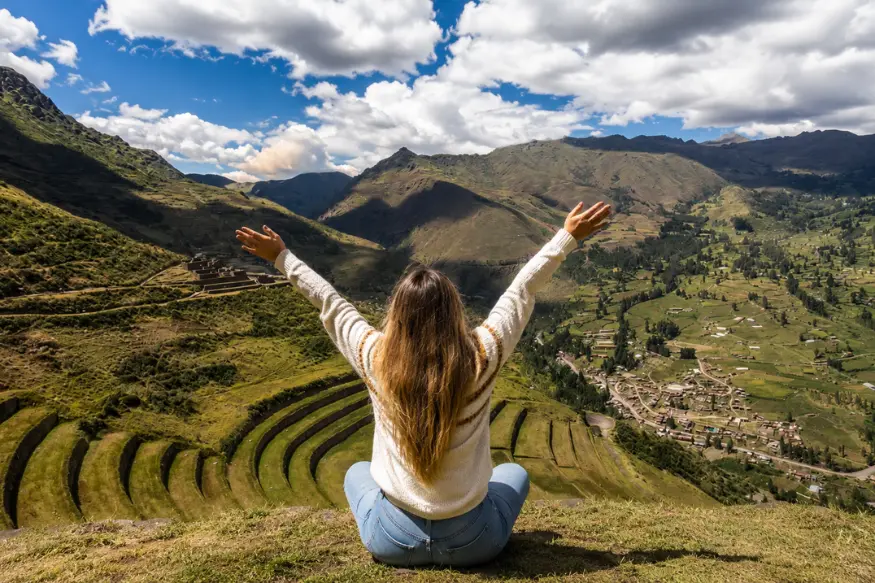
One day in the Sacred Valley works when you choose a focused route. Two days make more sense when you want a hotel stay, longer visits or time for experiences beyond the main archaeological stops. The decision is less about collecting attractions and more about the pace you want before or after Machu Picchu.
There is an important distinction: two days in the Sacred Valley is not the same as a two-day Sacred Valley and Machu Picchu package. Check where each day is spent before comparing itineraries.
| Your priority | Better starting point |
|---|---|
| A focused introduction without changing hotels | One day |
| More time at sites and fewer rushed transitions | Two days |
| An evening at a valley hotel | Two days with a confirmed overnight stay |
| Visiting the valley before a train departure | Either, depending on the actual train schedule |
| Adding a community visit or specialist activity | A tailored plan, often easier across two days |
These are planning recommendations, not fixed tour inclusions.
Start by choosing a geographical focus. PROMPERÚ identifies Pisac, Chinchero, Maras, Moray and Ollantaytambo among the valley’s principal cultural destinations. That does not mean every visit belongs in the same day. Official Sacred Valley overview.
A focused itinerary might emphasize Pisac and Ollantaytambo, or Chinchero, Maras and Moray. Decide which places matter most, then build the road journey, lunch and walking time around them. If you finish at a train station, treat the departure as a fixed appointment rather than an optional final stop.
Use our Sacred Valley travel guide to choose your priorities. For more detail, compare the Pisac ruins guide with the Chinchero visitor guide.
A second day is valuable when it changes the experience, not simply the number of stops. It can create room for a slower archaeological visit, a separate market visit or an evening at your hotel without immediately returning to Cusco.
One possible structure is to explore the Pisac side on one day and the Chinchero–Maras–Moray area on another, fitting Ollantaytambo around your onward journey. This is an illustrative route, not a confirmed departure or a promise that every attraction can be combined.
Community visits, textile workshops, meals and outdoor activities need their own arrangements. Do not assume they are included because a destination appears near your route on a map.
Choose the overnight location after deciding what happens the following morning. An accommodation that looks attractive in isolation may add an unnecessary transfer to your next activity.
Compare the practical differences in our Urubamba guide and Ollantaytambo town guide. Then check the precise hotel address, check-in arrangements and the luggage plan for your onward journey.
An overnight stay should give you time to enjoy the property. Arriving late and leaving before breakfast may offer less value than the itinerary’s hotel description suggests.
Not necessarily. Meta Peru Travel’s published two-day Sacred Valley and Machu Picchu tour combines a valley visit and onward train journey on the first day with Machu Picchu on the second. It is a combined journey, rather than two full sightseeing days in the valley.
That can suit travelers who want coordinated logistics. If your goal is two days exploring the valley itself, request that explicitly and ask how many additional nights the complete trip requires.
Use the following outline as a starting point for a custom itinerary, rather than a fixed departure schedule. Your hotel location and next train journey may change the order.
| Day | Suggested focus | Decision to make |
|---|---|---|
| First valley day | Pisac archaeology and a separate market visit | How much time do you want for walking versus shopping? |
| Second valley day | Chinchero, Maras and Moray | Are you returning to Cusco or continuing toward Ollantaytambo? |
| Optional extension | Ollantaytambo or a community-hosted experience | Does it need another half day or overnight stay? |
Keep a visit to the archaeological terraces separate from time in a town or market. Walking through ruins, eating lunch and finding a meeting point all take time, even when the distance on a map looks short. If Ollantaytambo is a priority, give the visit its own place in the plan rather than treating it only as the location of your train.
For a community experience, our Misminay guide explains why arrangements with local hosts should be confirmed separately. A second day is useful only if it creates room for the experience you actually want.
Are you returning to Cusco or continuing by train? Which two or three experiences matter most? Do you want a hotel stay or simply more sightseeing time? Are guiding, entrance tickets, meals and activities included? Where will larger luggage stay during the Machu Picchu portion?
For a short trip, a selective day is often more satisfying than a crowded checklist. For a slower journey, request two days that genuinely create space. Share your dates, preferred stops and onward travel details so the itinerary can be designed around those decisions.
Published by Meta Peru Travel.