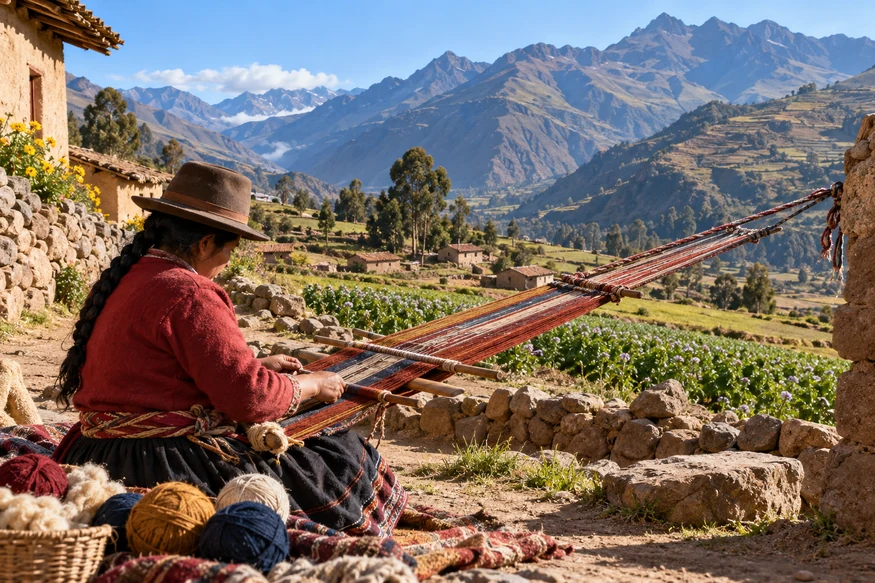
Chahuaytire is a high-Andean Quechua community near Pisac, known for living textile traditions, agriculture, ancient rock art and sections of the Qhapaq Ñan. It offers a culturally meaningful extension to the Sacred Valley for travelers who want to understand how weaving, farming and communal authority remain part of everyday life.
Chahuaytire is a campesino community in Pisac District, Calca Province. The Municipality of Pisac identifies agriculture, textile art and experiential tourism among the community's defining activities.
This is not an open-air museum. Families live and work here, so a visit should be arranged through an authorized local host, association or qualified operator.
The community lies in the highlands beyond Pisac, on the route toward Paucartambo. It is part of the wider Sacred Valley cultural landscape, although it sits higher and feels more rural than the valley-floor towns.
Road conditions and the exact meeting point can vary. Confirm the route, vehicle type and community contact before leaving Cusco or Pisac.
Chahuaytire brings together several layers of Andean history: pre-Hispanic rock art, Inca road sections, farming and a continuing weaving tradition. Peru's cultural authorities have also documented archaeological places in the area, including Inka Raqay.
The strongest reason to visit is not simply to buy a textile. It is to understand how knowledge, materials, symbols and community organization remain connected.
Local artisans work with wool, natural color traditions and inherited designs. A demonstration may explain spinning, dyeing, loom preparation and the meaning of motifs, but the content depends on the host and should never be treated as a staged performance owed to visitors.
Buy directly when possible, ask before handling finished pieces and avoid aggressive bargaining. Handwoven work reflects many hours of skilled labor.
The Municipality of Pisac describes Chahuaytire as the home of ancient rock paintings. Peru's Ministry of Culture has also reported Inca road segments, rock shelters with paintings and the archaeological site of Inka Raqay in the area.
Access may require local permission or guidance. Never touch, trace, wet, climb near or use flash on painted surfaces, and do not publish exact sensitive locations without community approval.
Documented Inca road sections connect this landscape to the larger Qhapaq Ñan network. Walking a permitted segment can add context to Pisac's role between Cusco, the Sacred Valley and routes toward the Antisuyo.
Use a local guide, stay on the authorized path and expect high-altitude terrain rather than a polished urban walkway.
The most reliable plan is private transport with a confirmed community appointment. Travel commonly follows the road to Pisac before continuing into the highlands; journey time depends on traffic, weather and the chosen access point.
Meta Peru's City Tour and Pisac Full Day provides a useful basis for a private eastern Sacred Valley itinerary. Ask in advance whether a separate Chahuaytire experience can be coordinated without rushing Pisac.
Pisac's archaeological park explains the monumental Inca landscape, while Chahuaytire adds living textile and community traditions. The two are complementary rather than interchangeable.
The Pisac market is easier to visit independently. Chahuaytire requires more preparation and respectful coordination.
| Factor | Chahuaytire | Chinchero |
|---|---|---|
| Setting | High rural community beyond Pisac | Major Sacred Valley town |
| Main focus | Community weaving, agriculture and rock art | Archaeology, colonial heritage, market and weaving |
| Planning | Prearranged host or guide recommended | Regular visitor infrastructure |
| Best pairing | Pisac and the eastern valley | Maras, Moray or Piuray |
Choose according to route and depth of experience, not because one destination is more “authentic” than the other.
Dry-season months generally provide more predictable roads and walking conditions. Wet-season travel brings greener fields but can also mean rain, mud, cloud and longer transfers.
Morning is practical for a community visit and leaves time for Pisac afterward. Confirm seasonal access and local availability rather than relying on a fixed online schedule.
Chahuaytire is higher than Pisac and can feel cold even when the valley is sunny. Acclimatize first and bring warm layers, rain protection, sun protection, water and shoes with good grip.
Arrange the visit, compensate hosts fairly and follow instructions about photography and sacred or archaeological places. Do not enter homes, fields or workshops without invitation.
Avoid language that reduces residents to costumes or photo opportunities. Chahuaytire is a contemporary community whose traditions continue because local people choose to practice and transmit them.
Yes for travelers interested in weaving, living Quechua culture, archaeology and a quieter eastern Sacred Valley itinerary.
Independent arrival is not the best approach. A local host or qualified guide helps with permission, interpretation, language and respectful access.
Yes with private transport and an appointment, but allow enough time for both experiences and avoid adding too many other stops.