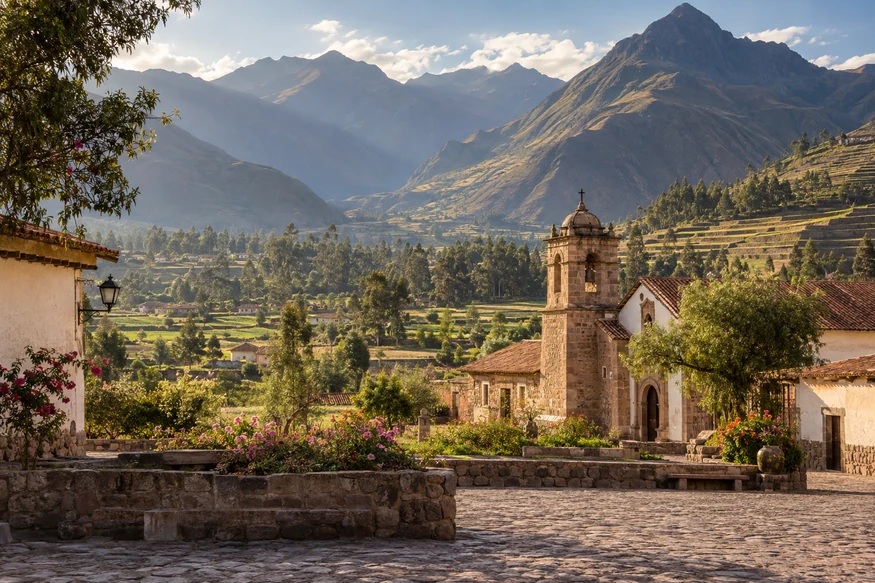
Yucay, Peru, is a quiet historic town in the Sacred Valley between Pisac and Urubamba. Known for its mild valley setting, colonial-era plaza and extensive agricultural terraces, it appeals to travelers who want a slower experience away from the busiest tour stops.
This guide covers what to do in Yucay, how to get there, where to stay and how to include the town in a wider Sacred Valley itinerary.
Yucay lies on the Sacred Valley floor a short road journey southeast of Urubamba. It sits along the main valley corridor linking Pisac, Calca, Urubamba and Ollantaytambo.
The town is smaller and quieter than Cusco or Urubamba. Its appeal comes from the relationship between the plaza, traditional streets, farmland and mountains rather than from a long list of ticketed attractions.
Visit Yucay for a relaxed look at Sacred Valley town life, historic architecture and agricultural landscapes. It is a good fit for travelers who have already allowed time for the better-known archaeological sites.
Visitors with a very short itinerary may prioritize Pisac, Ollantaytambo, Maras or Moray. Yucay works best as a thoughtful addition, not a hurried replacement for those major sites.
The central area is a natural starting point for noticing colonial-Andean architecture and the town's slower rhythm. Remember that it is a living community and ask permission before photographing residents.
Terraces rise around the town and reflect the valley's long agricultural history. View them from authorized public routes and never cross private fields without permission.
A gentle walk connects the plaza with quiet streets, gardens and views toward the mountains. Confirm local access before following paths that leave the settled area.
Accommodation in and around Yucay suits travelers who value gardens, scenery and rest. Check the exact location of each property, as some require private transport for meals and excursions.
Most visitors travel by road through the Sacred Valley. The duration depends on the chosen route, traffic and planned stops. Private transport is simplest with luggage or a multi-stop day.
A broader Sacred Valley tour can coordinate the region's principal attractions. Ask whether a Yucay stop or hotel drop-off can be included before booking.
| Consideration | Yucay | Urubamba |
|---|---|---|
| Atmosphere | Small, quiet and historic | Larger working town |
| Restaurants and services | More limited | Broader selection |
| Best for | Restful lodge stay | Practical multi-night base |
| Transport | Often easier with arrangements | More local connections |
Choose Yucay for tranquility and Urubamba for convenience. Always compare the actual hotel location rather than relying only on the town named in a listing.
A half day is enough for a relaxed plaza and town walk. One night makes sense when the accommodation and peaceful setting are part of the experience.
Yucay can also be a gentle stop between Pisac and Urubamba, provided it does not force an unrealistic schedule across both ends of the valley.
The dry season generally offers more predictable walking conditions and clearer mountain views. The rainy season creates greener fields but may affect rural paths and road timing.
Morning is comfortable for walking; late afternoon brings softer light. Carry both sun and rain protection because valley weather changes quickly.
Yes. Yucay is a historic town on the Sacred Valley floor near Urubamba.
Yes for travelers seeking a quiet town, terraces and a slower valley experience.
Yes. The town and surrounding countryside include lodging options, but confirm access, meals and transfers before booking.