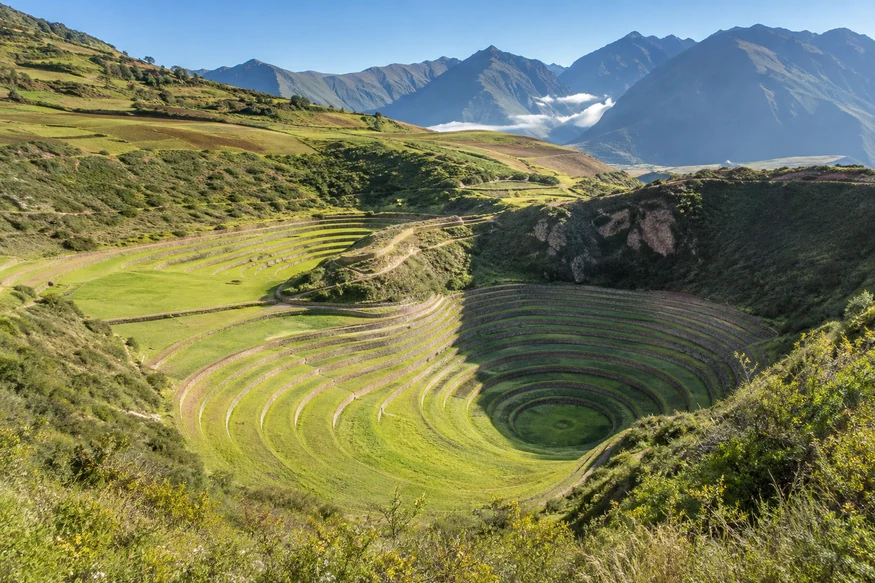
Moray is an Inca archaeological site in Peru's Sacred Valley famous for its enormous concentric terraces. The circular depressions create one of the region's most recognizable landscapes and demonstrate the Incas' sophisticated control of terrain, drainage and cultivation.
This guide explains Moray tickets, opening hours, transportation from Cusco, what the terraces may have been used for and how to combine Moray with the Maras Salt Mines.
Moray consists of several terraced depressions, including a principal circular complex that descends in broad concentric rings. Stone retaining walls, stairways and drainage systems allowed the slopes to remain stable.
The site is often described as an Inca agricultural laboratory. That interpretation is plausible and popular, but the exact combination of agricultural, ceremonial and administrative functions is still debated.
Moray lies northwest of Cusco near Maras town, above the main floor of the Sacred Valley. Its high plateau setting is colder and more exposed than Urubamba or Ollantaytambo.
The archaeological entrance is reached by rural roads. Moray and Maras Salt Mines are distinct attractions and should not be treated as the same stop.
Private transport normally takes around 1.5 hours without long stops. The most efficient route often includes Chinchero, Moray and Maras in a single loop.
Independent public transport requires additional local connections and does not always align with attraction hours. Meta Peru Travel offers a half-day Chinchero, Moray and Maras experience.
Moray is normally included in the Cusco Tourist Ticket's Sacred Valley circuit and in the Integral Ticket. The same ticket can include Pisac, Ollantaytambo and Chinchero, depending on the selected circuit.
Verify current tariffs, validity and sales rules with COSITUC. The nearby Maras Salt Mines require a separate admission payment.
Opening times can change during holidays, maintenance or exceptional conditions. Confirm the current schedule before departure.
Morning usually provides clearer skies and fewer groups. Midday sun emphasizes the geometry but offers less shade, while afternoon weather can be less predictable in the rainy season.
Allow one to 1.5 hours to walk the authorized viewpoints and understand the principal terraces. A rushed stop can be completed faster, but it reduces Moray to a photograph.
Travelers moving slowly at altitude should reserve extra time. Paths include uneven ground and changes in elevation.
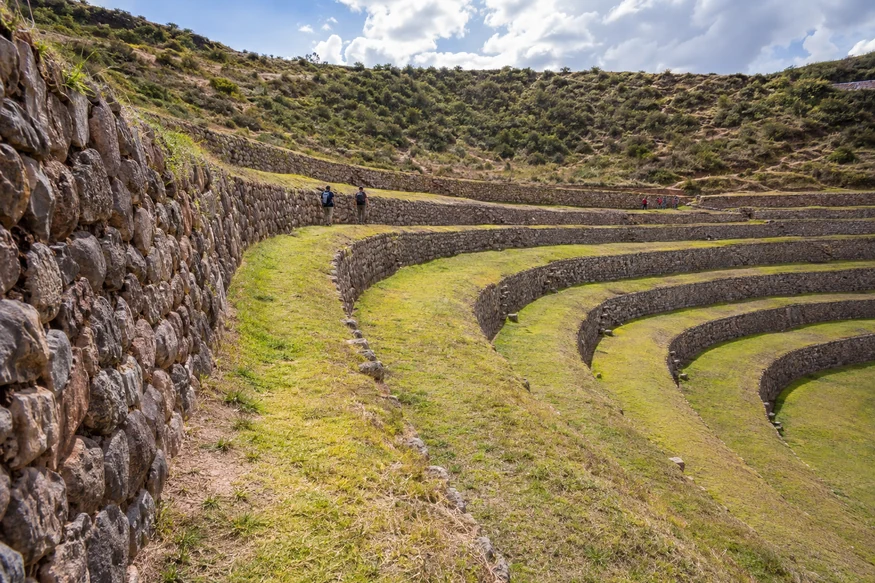
The leading interpretation connects Moray with agricultural experimentation. Differences in depth, orientation, soil and exposure may have created varied growing conditions.
However, statements that every terrace reproduces a precise ecological zone or temperature should be treated cautiously unless supported by current archaeological research. Moray's construction also had social, political or ceremonial meaning that cannot be reduced to a modern greenhouse comparison.
Builders shaped natural depressions with retaining walls, layered soils, stairs and drainage. The circles channel water and stabilize steep surfaces while creating cultivable platforms.
The fact that the deepest sectors do not normally flood demonstrates careful water management. Visitors should remain on authorized routes to avoid damaging walls and soil.
The principal viewpoints are relatively accessible compared with a mountain hike, but Moray sits around 3,500 meters. Recently arrived travelers may feel breathless even during short walks.
Use sun protection, drink water and avoid running up steps. Accessibility conditions should be confirmed if a traveler uses a wheelchair or has limited mobility.
| Feature | Moray | Maras Salt Mines |
|---|---|---|
| Type | Inca archaeological terraces | Working salt-production landscape |
| Ticket | Cusco Tourist Ticket | Separate local admission |
| Time needed | 1–1.5 hours | 45–90 minutes |
| Terrain | High open plateau | Steep canyon |
Neither replaces the other. Visit both for a stronger understanding of how Andean communities have adapted water, minerals and terrain.
Yes. Their locations form a practical route from Cusco into the Sacred Valley. Begin early, allow proper time at each attraction and account for rural road conditions.
A full-day Sacred Valley tour with Maras and Moray can continue to other major sites, while a half-day route focuses on the western valley.
Arrive early, use only authorized paths and avoid climbing terrace walls. Keep the original wide-angle view in perspective: the site deserves interpretation, not only drone-style photographs.
Continue planning with our Maras Salt Mines guide and the Sacred Valley luxury travel guide.
Yes, especially with Maras. Its concentric terraces are unlike the architecture at Pisac or Ollantaytambo.
Moray is normally included in the relevant Sacred Valley circuit. Verify current ticket rules with COSITUC.
Access routes can be restricted for conservation. Follow the current signs and instructions rather than crossing barriers.
For the next steps, explore Urubamba Peru: What to Do, Where to Stay and Travel Tips.
Published by Meta Peru Travel.