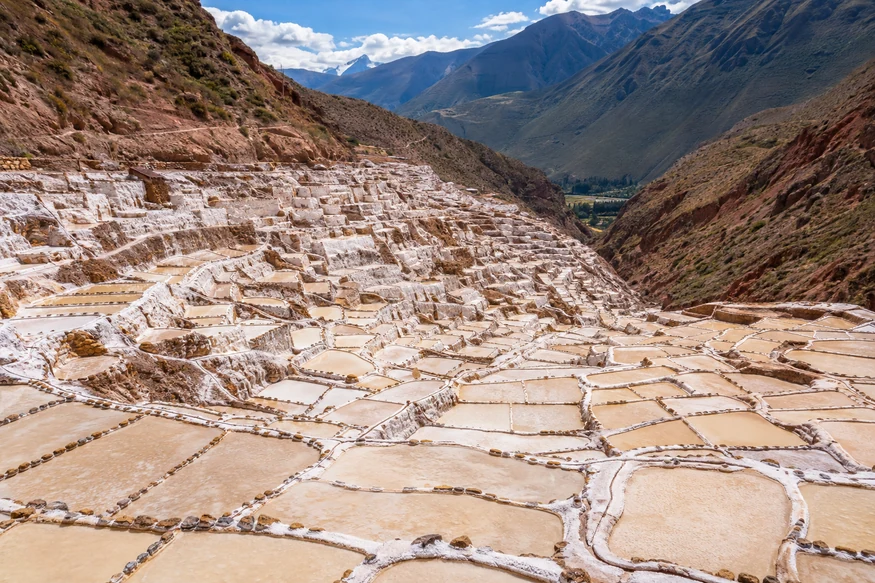
The Maras Salt Mines, known locally as Salineras de Maras, are thousands of traditional salt ponds arranged across a steep canyon in Peru's Sacred Valley. Salty spring water moves through small channels into family-managed pools, where sun and dry air gradually leave mineral salt behind.
This guide covers entrance fees, opening times, how to reach Maras from Cusco, the best viewpoints and how to combine the salt mines with Moray.
Maras is a working salt-production landscape rather than an abandoned archaeological monument. A naturally saline spring feeds a network of channels that distributes water among thousands of shallow ponds.
Evaporation concentrates the minerals, and salt is collected in stages. The visual pattern changes with weather, water levels and the production cycle.
The salt ponds lie below Maras town, west of Cusco and north of the main Sacred Valley road. They are commonly visited with Moray because both attractions are relatively close but reached by different local roads.
The final approach includes curves and exposed canyon views. Travel time depends on the chosen route and current road conditions.
Private transport generally takes around 1.5 hours without extended stops. Organized routes often travel through Chinchero and Moray before continuing to Maras.
Public transport does not usually deliver visitors directly to the entrance, so independent travelers may need multiple connections. The Chinchero, Maras and Moray tour provides the simplest coordinated option.
Maras uses a separate local admission system and is not included in the Cusco Tourist Ticket. The fee supports access and management of the working salt landscape.
Prices and payment arrangements can change. Carry Peruvian soles and confirm the current fee before departure. A tour price may or may not include admission, so check the inclusion list.
Operating hours can change seasonally or because of community decisions, maintenance and weather. Confirm the current schedule locally before building a tightly timed itinerary.
Morning visits often provide clearer conditions and work well when continuing to Moray. Afternoon light can create stronger contrast across the ponds, although rain clouds may develop in wet months.
The dry season generally produces bright ponds and dependable road conditions, while the rainy season creates greener surrounding mountains and more variable pond colors. Neither season guarantees a particular appearance.
For photography, avoid judging the site by a single viral image. Production stages, recent rain and sunlight determine whether ponds appear white, beige, pink or brown.
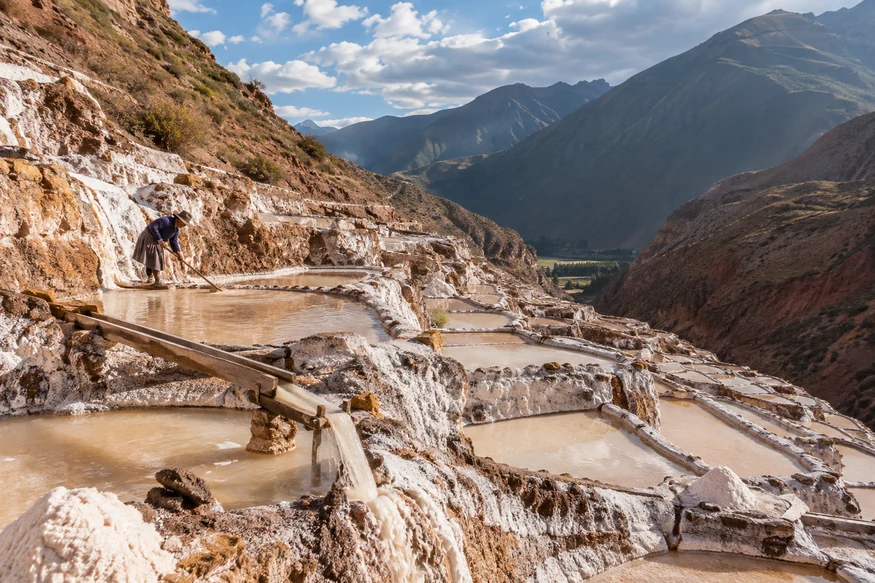
Most visitors need 45 to 90 minutes for viewpoints, interpretation and the local sales area. The site is best appreciated slowly rather than as a five-minute roadside photograph.
Access within the ponds may be restricted to protect workers, visitors and salt quality. Follow the authorized route and do not step into production areas.
Saline water is directed into shallow family-managed ponds. Sun and wind evaporate the water, concentrating salt crystals that are gathered in successive layers.
Different grades can be separated for culinary or other uses. The system depends on shared channels and coordinated maintenance, making Maras both a cultural landscape and an active community enterprise.
Visitor access between ponds has been restricted in recent years to protect hygiene and operations. Current boundaries can change, so follow signs and community staff.
The designated viewpoints still provide broad views. Drones should not be used without explicit authorization.
Yes. Maras and Moray are one of the Sacred Valley's most practical combinations. Allow roughly one hour at Maras and one to 1.5 hours at Moray, plus driving time.
| Feature | Maras Salt Mines | Moray |
|---|---|---|
| Purpose | Working salt production | Inca terraced archaeological complex |
| Admission | Separate local ticket | Cusco Tourist Ticket circuit |
| Typical visit | 45–90 minutes | 1–1.5 hours |
| Main appeal | Living tradition and canyon landscape | Circular terraces and Inca engineering |
Respect barriers, avoid touching salt or water channels, and purchase from authorized local sellers. This is a workplace shared by many families, not an open-air stage set.
For the surrounding region, read our Sacred Valley luxury travel guide and the companion Moray Peru guide.
Yes, particularly when combined with Moray. The site offers a distinctive living tradition and one of the Sacred Valley's most unusual landscapes.
No. Maras has a separate local admission fee.
Authorized sales areas offer packaged salt products. Check food-import rules before carrying them internationally.