Potato Park Peru, known locally as Parque de la Papa, is an Indigenous-led agrobiodiversity territory in the high Andes above Pisac. Its Quechua communities conserve native potato varieties, farming knowledge, food traditions and mountain ecosystems while welcoming visitors through prearranged community-guided experiences.
Potato Park is a community-managed landscape created to protect native crops, ecological knowledge and Quechua culture. It is not a conventional amusement park or a single fenced attraction. Farms, homes, wetlands, lakes and high-altitude grasslands form one connected territory.
Peru officially recognized Parque de la Papa as an Agrobiodiversity Zone in 2020. That designation acknowledges both its biological richness and the local cultural systems that conserve it.
The park lies in Pisac District, Calca Province, in the Cusco region. Its communities are reached by road from Pisac, with different meeting points depending on the program and host community.
The park's own visitor information estimates approximately 15 to 30 minutes by vehicle from Pisac and around one hour from Cusco under favorable conditions. Always confirm the exact community, driver and meeting point before departure.
The officially recognized agrobiodiversity zone includes the communities of Chahuaytire, Amaru, Paru Paru and Pampallacta. Current local tourism materials may also reference collaboration with neighboring Sacaca.
Each community has its own territory, activities and responsibilities. A Potato Park visit therefore varies according to season, agricultural work and the program arranged with local hosts.
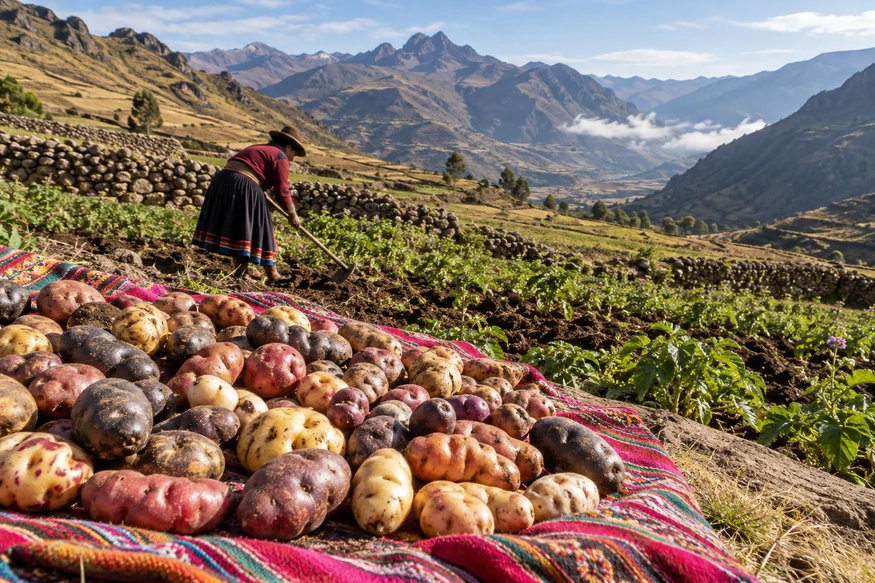
Official Peruvian sources describe more than one thousand native potato varieties conserved in fields and community seed collections. Their colors, shapes, textures and growing requirements reflect generations of selection in different soils and microclimates.
This diversity is useful for food security and climate adaptation. A visit helps explain why conservation means continuing to cultivate, exchange, cook and value the varieties—not simply displaying them.
A community guide may explain seed selection, planting cycles, cultivation at different elevations and the relationship between families and particular varieties.
Programs can include an interpretation space or communal seed bank. Access depends on the agreed itinerary and current community operations.
Community-prepared meals can feature native potatoes and other Andean ingredients. State allergies and dietary restrictions before confirming the visit.
Some programs include weaving or Andean plant traditions. Ask before taking photographs or handling textiles, tools and botanical materials.
Peru's official tourism promotion highlights Azul Qocha and Kinsa Qocha among possible park experiences. These lakes sit within a high-altitude landscape where weather can change rapidly.
Lake access is route- and season-dependent. Do not assume that every standard visit includes them, and never enter wetlands or sensitive shorelines without a guide.
The Potato Park states that visits are available by prior arrangement and are led by local guides. Contact the park or use a responsible operator before travel rather than arriving unannounced.
Confirm the host community, included activities, meal, walking difficulty, language, total price, payment method and how the fee benefits local participants.
Most routes travel from Cusco to Pisac and then continue uphill by private vehicle. A driver familiar with the communities is preferable because map pins do not replace a confirmed local meeting point.
Meta Peru's City Tour and Pisac Full Day can serve as the basis for a customized eastern Sacred Valley plan. Potato Park generally deserves its own full day, so ask for a private itinerary rather than adding it as a rushed final stop.
Official tourism information places the wider park between roughly 3,150 and 4,619 meters above sea level. The exact altitude depends on the community and activity.
Acclimatize in Cusco or the Sacred Valley before strenuous walking. Move slowly, drink water and tell your guide immediately if you develop persistent headache, nausea, dizziness or unusual shortness of breath.
Peru's official tourism platform recommends April through October for more predictable conditions. Agricultural experiences, however, vary through planting, flowering and harvest cycles, so no single month shows every activity.
Rainy-season visits can reveal greener fields but may involve mud, cloud, road delays or adjusted walking routes. Confirm conditions shortly before departure.
| Factor | Potato Park | Pisac Archaeological Park |
|---|---|---|
| Main focus | Living agriculture, biodiversity and community knowledge | Inca architecture, terraces and ceremonial sectors |
| Visit format | Prearranged community-guided program | Ticketed archaeological visit |
| Typical time | Full day | Two to four hours |
| Access | Different community meeting points | Established road and visitor route |
They answer different travel interests and complement each other rather than competing for the same experience.
If you have two days, dedicate one to the community experience and one to the archaeological park and Pisac Market. This gives each place enough time and avoids turning community tourism into a photo stop.
Travelers with only one day should choose the experience that best matches their priorities or arrange a carefully limited private program.
Keep luggage compact and ask whether lunch, water refills or walking poles are included.
Follow local guides, remain on authorized paths and never remove plants, seeds, stones or archaeological material. Ask before photographing people, homes, ceremonies, food preparation or seed collections.
Buy directly when appropriate and avoid aggressive bargaining. The park is a living agricultural territory whose conservation depends on community decisions, skilled labor and respect for Indigenous knowledge.
Yes for travelers interested in native crops, food culture, community tourism, Andean landscapes and conservation beyond the standard archaeological circuit.
No independent drop-in visit should be assumed. The park requests prior arrangement and offers community-led guided experiences.
A full day is recommended for a meaningful program from Cusco. Shorter arrangements may be possible from Pisac when confirmed directly.
No. Potato Park is a living agrobiodiversity territory, while Pisac Archaeological Park is a protected Inca complex.