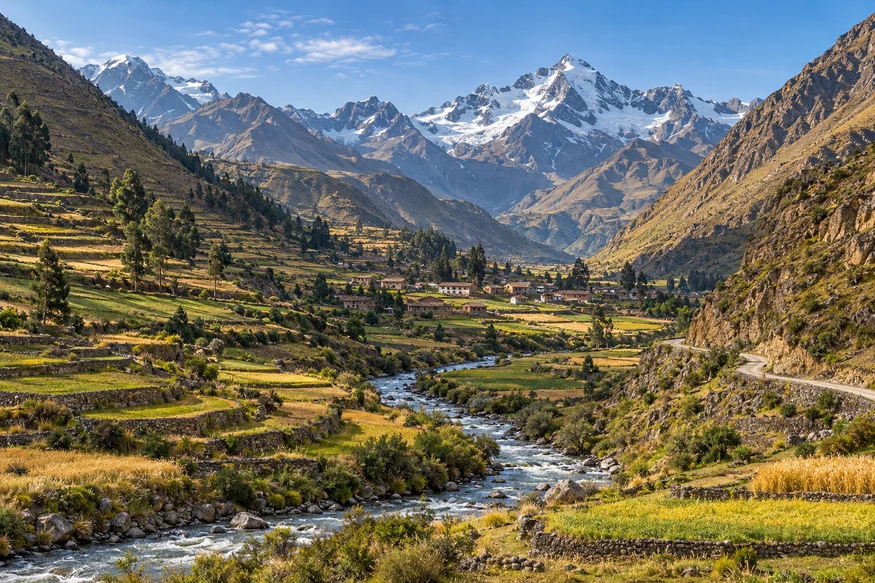
Patacancha Valley is a high Andean valley above Ollantaytambo, known for mountain scenery, farming communities and living textile traditions. It offers a more rural experience than the main Sacred Valley corridor, but travel requires thoughtful transport, altitude awareness and respect for community life.
Patacancha is both a river valley and a network of highland communities northeast of Ollantaytambo. The road climbs away from the busy rail town through cultivated slopes, grazing land and increasingly dramatic mountain scenery.
The valley is not a single attraction with a gate or fixed circuit. A good visit is built around the landscape, locally agreed community experiences and enough time to travel without turning villages into quick photo stops.
The valley begins near Ollantaytambo town in the Cusco region and follows the Patacancha River into the high Andes. Its communities sit at considerably higher elevations than the Sacred Valley floor.
Because locations described as “Patacancha” may refer to different communities or trailheads, confirm the exact meeting point and route before leaving Ollantaytambo.
Travelers come for expansive mountain views, traditional agriculture, weaving knowledge and a quieter perspective on life beyond Peru's principal archaeological circuits. The experience is strongest when arranged with a responsible local partner and approached as a cultural visit rather than a staged attraction.
Patacancha and Willoq are among the best-known communities associated with the valley. Residents maintain Quechua language, farming and textile traditions while also participating in tourism and regional trade.
Visits should be coordinated rather than improvised. Community activities, demonstrations and access depend on local schedules, consent and season.
Textiles communicate skill, identity and community knowledge through fiber preparation, natural colors, pattern and technique. When buying, ask who made the piece, which materials were used and how payment reaches the maker.
A respectful textile encounter allows artisans to explain their work without pressure. Avoid treating clothing or ceremonies as props, and always ask before photographing people.
Private transport with a locally experienced driver is the most practical option for most visitors. The mountain road is narrower and less predictable than the main Sacred Valley highway, and conditions can change after rain or road works.
Agree on the destination, waiting time and return plan in advance. Mobile coverage should not be assumed throughout the valley.
Communities in the valley are higher than Ollantaytambo, so visitors may feel the elevation even after time in the Sacred Valley. Acclimatize first, move slowly, hydrate and communicate symptoms to your guide.
Anyone with medical concerns should seek individualized professional advice before high-altitude travel.
The dry season generally brings more dependable road and walking conditions, along with cooler nights. The rainy season makes the valley greener but can also cause mud, reduced visibility and transport delays.
Weather changes quickly at altitude in any month. Carry both sun protection and a waterproof layer.
The valley is closely connected to Pumamarca Ruins, a quieter archaeological site reached through a combination of road travel and hiking. They can complement each other, but not every Pumamarca route includes a community visit.
Ask for the exact walking distance, elevation change and vehicle logistics before combining them.
| Factor | Patacancha Valley | Classic Sacred Valley |
|---|---|---|
| Main experience | Highland communities and scenery | Major ruins, markets and towns |
| Road access | Narrow mountain route | Main paved corridor |
| Altitude | Higher than the valley floor | Generally lower |
| Best for | Slow cultural travel | First-time highlights |
First-time visitors with limited time often prioritize Ollantaytambo Ruins, Pisac, Maras and Moray. Patacancha is ideal when an additional half or full day is available.
Yes. Start from Ollantaytambo and allow a flexible half day or full day depending on the community program, road conditions and any planned hike. Avoid scheduling the visit immediately before a fixed train departure.
Meta Peru's Sacred Valley tour covers the classic route; ask the team for a separate, customized Patacancha plan rather than assuming it is included.
Use authorized local services, follow community guidance and ask permission before taking photographs. Do not enter homes, farmland or ceremonial spaces without an invitation. Pay fairly for textiles and experiences, and avoid bargaining that undervalues skilled work.
Yes for travelers interested in mountain scenery, textiles and respectful community-based experiences beyond the busiest Sacred Valley sites.
Travel time varies by the exact community, weather and road conditions. Confirm the route and realistic return time with a local operator.
Transport may be arranged independently, but a locally connected guide is strongly recommended for communication, context and coordination with communities.